Skate Spots Are Vanishing. Here's Who's Fighting to Save Them.
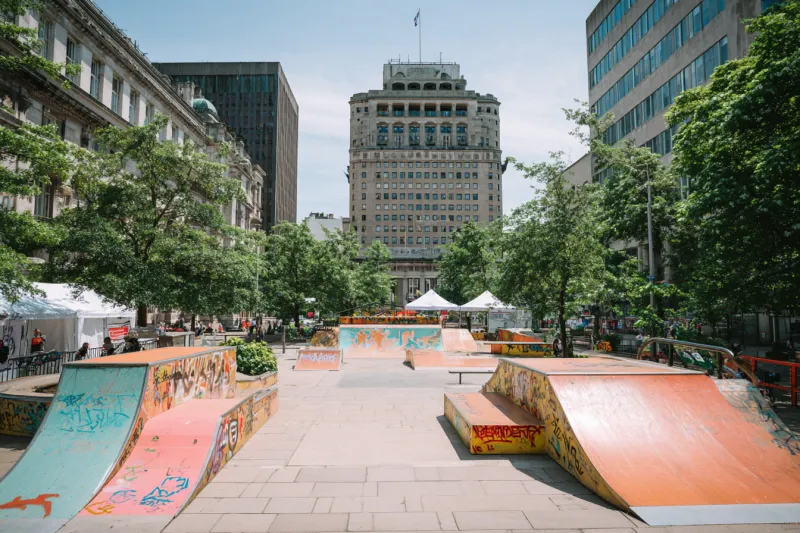
Photo: urban skate spot concrete ledge city plaza skateboarding street, via outuro.com
There's a particular kind of grief that skaters know well. You show up to a spot you've been skating for years—maybe a smooth marble ledge outside a federal building, or a perfectly angled bank behind a parking garage—and it's gone. Not gone like moved-on gone. Gone like someone bolted metal brackets every six inches along the edge, or poured fresh concrete into the run-up, or strung a chain-link fence across the whole approach. Gone like they knew exactly what they were doing.
That feeling is becoming more common. Across the United States, prime street skating terrain is disappearing at a pace that's hard to ignore. And the forces behind it—urban redevelopment, anti-skate architecture, and increasingly aggressive municipal ordinances—aren't slowing down.
The Architecture of Exclusion
The term "hostile architecture" usually gets applied to anti-homeless design: benches with armrests that prevent lying down, spikes under overpasses, curved bus shelter seats. But skaters have been living with their own version of this for decades. Skate stoppers—those metal brackets bolted onto ledges—have been around since the late '80s. What's changed is the scale and sophistication of the effort.
Modern urban development projects are increasingly designed from the ground up with skateboarding prevention baked in. Rough aggregate concrete, intentionally uneven surfaces, narrow ledges that slope slightly inward—these aren't accidents. They're design choices. Architects and city planners are consulting explicitly on how to make public spaces "skate-resistant," a phrase that has started appearing in actual municipal planning documents.
In cities like San Francisco, Chicago, and New York, the problem is compounded by gentrification. When a neighborhood gets redeveloped, the raw urban texture that makes it skateable—the loading docks, the empty plazas, the forgotten corners of civic architecture—gets sanded down into something polished, surveilled, and inhospitable. The spots that defined a city's skate scene for a generation get swapped out for manicured green spaces and mixed-use developments with security guards on rotation.
"Every time a neighborhood 'improves,' we lose something," says Marcus Webb, a 34-year-old skater and community organizer based in Philadelphia. "The spots that made Philly legendary—Love Park, LOVE Park's surrounding blocks—they didn't survive 'improvement.' They got loved to death by people who didn't actually love skating."
The Ordinance Problem
Beyond architecture, municipal law has become one of the sharpest tools used against street skating. Skateboarding bans on public property are nothing new, but the enforcement landscape has shifted. In some cities, ordinances that were rarely enforced a decade ago are now being actively used—partly because of complaints from new residents in gentrified neighborhoods, and partly because of increased foot traffic from remote workers reclaiming public spaces post-pandemic.
In Los Angeles, skaters have faced escalating fines at spots that were essentially tolerated for years. In Atlanta, a cluster of downtown ledges that served as an informal gathering spot for the local scene got officially designated as a "no skating zone" following pressure from a nearby luxury development's property management company—even though the ledges were on public sidewalk.
The legal picture gets complicated fast. Public space law varies enormously by city and state, and skaters often don't have clear standing to challenge bans, especially when they're attached to property management agreements or HOA rules that affect semi-public spaces. But some advocates are starting to push back through the legal system.
Fighting Back: Legal Challenges and Reclamation Projects
In Portland, Oregon, a coalition of skaters and civil liberties advocates successfully challenged a park district ordinance that effectively banned skating in a public plaza by arguing it constituted viewpoint-neutral but content-based restriction on expressive activity—a First Amendment angle that's gaining traction in legal circles. The case didn't set a sweeping precedent, but it forced the city to revise the ordinance and create a designated skating window at the space.
That kind of legal creativity is becoming part of the skater activist toolkit. Organizations like the Skatepark Advocacy Network are helping local communities document spot closures, build public records cases, and connect with sympathetic attorneys. The argument isn't just cultural—it's civic. Public plazas are public. The architectural features in them were often paid for with public money. The idea that a city can retroactively ban a specific activity on public infrastructure raises real questions about equal access.
On the ground, spot reclamation is taking a more direct form. In Detroit, a group of skaters partnered with a local muralist collective to transform an abandoned parking structure into a semi-official skate spot, complete with painted obstacles and a community agreement with the building's owner. It's not a skatepark—it's a street spot with community backing, which is a meaningful distinction.
Similar projects have popped up in Baltimore, Memphis, and parts of the Bronx. The model usually involves identifying underused or abandoned urban space, building relationships with property owners or city officials, and creating enough community investment that the spot becomes harder to kill. It's not glamorous organizing work, but it's working.
The DIY Response
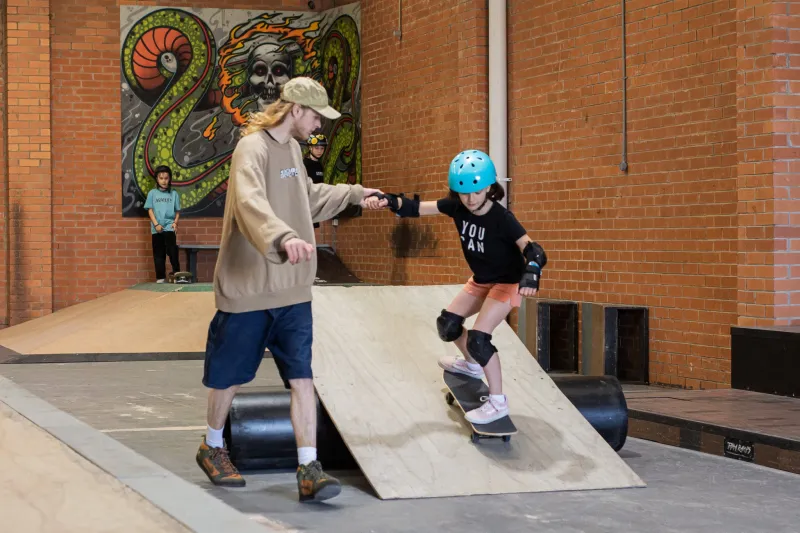
The DIY skate movement—which we've covered extensively here at Urban Skate Academy—is partly a direct response to spot loss. When the streets get locked down, skaters build their own terrain. Concrete pours in vacant lots, wood ramps in warehouses, guerrilla ledges in forgotten industrial zones. It's adaptation by necessity.
But DIY has limits. It can replace some of what gets lost, but it can't replicate the specific energy of skating real urban architecture. A hand-poured ledge in a warehouse is great. It's not the same as a marble plaza in the middle of a city, surrounded by people, connected to the actual pulse of urban life. That's what street skating is built on, and that's what's at stake.
What Actually Needs to Happen
Skaters who've been doing this advocacy work for a while are pretty clear-eyed about what moves the needle. Showing up to city council meetings matters. Building relationships with local business owners matters. Framing skating as economic activity—skaters spend money in neighborhoods, attract tourism, generate content that promotes cities—matters to people who respond to economic arguments.
What doesn't work as well: confrontational protests that give city officials easy reasons to dismiss the community, or purely online outrage that doesn't translate into civic participation.
"The spots aren't going to save themselves," Webb says. "And nobody's going to save them for us. We have to show up and make the case, every single time."
The ledges are disappearing. But so is the patience of a generation of skaters who've watched their culture get squeezed out of the cities it helped define. That tension is building toward something. The question is whether it breaks into real political power or just more skate stoppers.
We're betting on the skaters.