Don't Get Played: A Beginner's No-BS Guide to Buying Your First Skateboard
You've decided to learn to skate. Respect. But before you pull out your wallet, let's talk about the minefield standing between you and your first real setup. Between the mall kiosks selling flashy junk, the online rabbit holes full of conflicting advice, and the sheer volume of brands competing for your money, buying your first board can feel more overwhelming than landing your first ollie.
Here's the truth: a solid beginner setup doesn't need to cost a fortune, but it does need to be put together with some intention. Let's walk through every piece of the puzzle.
The Deck: Size Matters More Than Graphics
The deck is the wooden platform you ride, and it's where most beginners make their first mistake — buying based on looks instead of fit. Skateboard decks are measured in width, typically ranging from 7.5 inches to 8.5 inches and beyond. For most adults and teenagers just starting out, an 8.0 to 8.25-inch deck is the sweet spot. It's stable enough to learn balance on without feeling like a surfboard under your feet.
Kids under 10 or riders with smaller shoe sizes (under a men's 7) might want to go narrower, around 7.5 to 7.75 inches.
What to spend: A quality blank deck (no graphic) will run you $25–$40. A branded deck from a reputable company — Powell Peralta, Santa Cruz, Baker, Girl, Element — usually falls between $45–$65. Don't let anyone convince you that a $20 complete from a department store is the same thing. Those boards use low-grade maple and will feel dead under your feet almost immediately.
Skip: Any deck sold at Walmart, Target, or a tourist trap boardwalk shop. These are toys, not tools.
Trucks: The Unsung Heroes of Your Setup
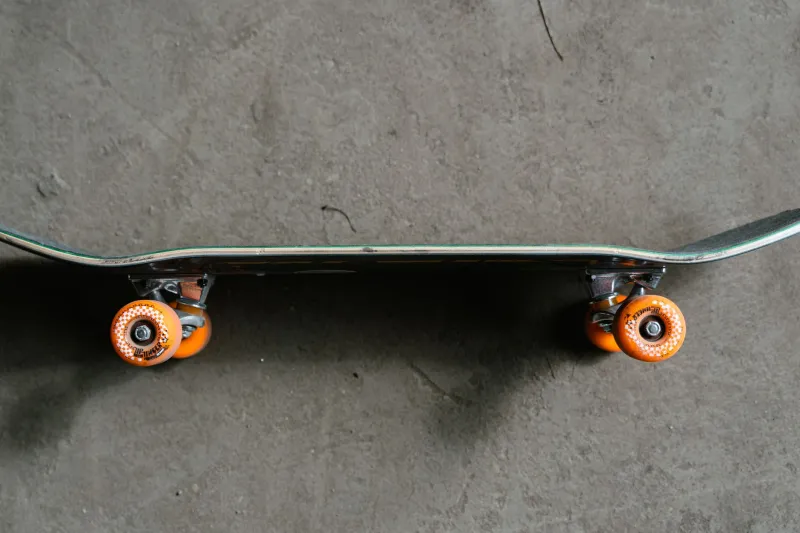
Trucks are the metal axles that attach your wheels to the deck. They control your turning, your stability, and how tricks feel when you land them. This is one area where quality really does make a difference — and where beginners often get shortchanged by cheap completes.
The two most important specs are width (match it to your deck — 5.0 trucks for decks around 7.75", 5.25 for 8.0–8.25") and height (low trucks for technical street skating, high trucks for more casual cruising).
Brands worth trusting: Independent, Thunder, Venture, Tensor. Any of these will serve a beginner well. Avoid no-name trucks that come stock on budget completes — they turn like a shopping cart and won't last.
What to spend: $30–$45 per pair. Yes, that's for both trucks together. If someone's charging you $25 per truck for a beginner setup, pump the brakes.
Wheels: Hardness and Size Are Everything
Skate wheels are rated on a durometer scale — the higher the number, the harder the wheel. Street skaters typically ride 99a–101a (very hard), which slides smoothly on concrete and pavement. Softer wheels (78a–87a) are for longboards and cruisers — they absorb bumps better but feel sluggish for tricks.
For size, 52–54mm wheels hit the sweet spot for beginners learning street skating. Too small and you'll catch every pebble; too big and flip tricks get awkward.
Reliable brands: Spitfire, Bones, OJ Wheels, Ricta. A set of quality wheels will cost $25–$45. Anything cheaper is probably made from a rebound formula that'll flat-spot (develop a dead patch) within weeks.
Bearings: The Piece Everyone Overthinks
Bearings sit inside your wheels and allow them to spin. They're rated on an ABEC scale (1–9) or by brand-specific standards. Here's the real talk: ABEC 5 or 7 bearings are all you need. The difference between a $15 set of Bones Reds and a $60 set of "precision ceramic" bearings is essentially zero for someone still learning to push and kick-turn.
Bones Reds ($15–$18) are the gold standard for beginners and plenty of pros. Affordable, fast, and durable. That's it. End of conversation.
The Complete Setup: What It Should Actually Cost
Here's a realistic breakdown for a quality beginner setup assembled from individual components:
| Component | Budget Pick | Mid-Range Pick |
|---|---|---|
| Deck | Blank – $30 | Branded – $55 |
| Trucks | Venture – $35 | Independent – $42 |
| Wheels | OJ Wheels – $28 | Spitfire – $38 |
| Bearings | Bones Reds – $16 | Bones Reds – $16 |
| Hardware/Grip | $10–$12 | $10–$12 |
| Total | ~$119–$125 | ~$163–$175 |
A pre-assembled complete from a reputable brand — Almost, Enjoi, Real, or Element — can be a solid shortcut, typically running $90–$130 and using decent components throughout. These are fine. What's not fine is a $40–$60 "complete" from a non-skate retailer.
Local Skate Shop vs. Online: Where Should You Buy?
This is a real debate, and both have merit. Here's how to think about it.
Go local when: You're buying your very first setup and want someone to help you size it right. Your neighborhood skate shop (often called an "LCS" in skate culture) is staffed by actual skaters who will steer you straight. Many shops will also assemble your board for free. Supporting local shops keeps skate culture alive in your city — that matters.
Go online when: You've already got some experience and know exactly what you want. Sites like Tactics, Skate Warehouse, and CCS carry massive selections, often at slightly lower prices, and run legitimate sales. Just know what you're ordering before you click buy.
Avoid: Amazon for skate components. Too many knockoffs, misleading specs, and zero accountability from sellers.
One Last Thing: Helmets and Pads Are Not Optional
This is a skateboarding school, so we're going to say it plainly — if you're just starting out, wear a helmet. Your board isn't the only investment worth protecting. Triple Eight and Pro-Tec make solid, affordable options that won't make you look like you're auditioning for a bike safety PSA.
Now go build your setup, get to the park, and start learning. The streets aren't going anywhere.