Head in the Game: The Mental Skills Every Skater Needs to Break Through Fear and Level Up
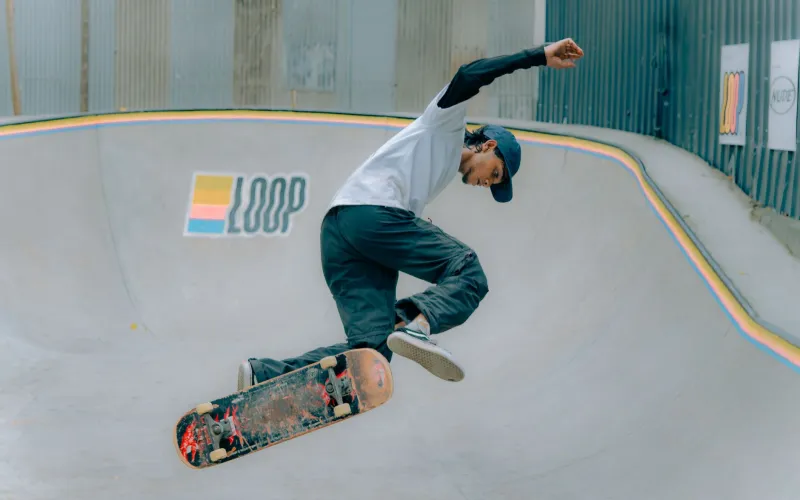
You've watched the clip a hundred times. You've got the foot placement dialed. You've rolled up to the spot and committed — then pulled out at the last second. Again. The frustration isn't just physical. Something else is going on, and no amount of extra practice is going to fix it until you address it directly.
Fear is the most honest thing about skateboarding. Unlike a lot of sports where the consequences of failure are abstract, skating makes them immediate and concrete. The pavement is right there. The bail is real. And yet, somehow, skaters at every level — from beginners working on their first ollie to pros hucking themselves down 12-stair handrails — find ways to push through. How?
The answer, it turns out, has less to do with toughness and more to do with technique. Mental technique.
Fear Is Information, Not a Stop Sign
Let's get one thing straight from the jump: fear isn't the enemy. Sports psychologists who work with action sports athletes are pretty consistent on this point. Fear is your nervous system doing its job — flagging potential danger and asking you to pay attention. The problem isn't feeling fear. The problem is misreading it as a signal to quit.
"A lot of skaters come to me thinking they need to eliminate fear entirely," says Dr. Alicia Nguyen, a sports psychology consultant who has worked with competitive skaters on the West Coast. "That's not realistic and honestly not desirable. What we work on is changing their relationship with the feeling — learning to act alongside it rather than waiting for it to go away."
This reframe is foundational. When you feel that spike of anxiety rolling up to a gap or a ledge, you're not broken. You're human. The skaters who progress fastest aren't fearless — they've just developed better tools for working with that feeling rather than against it.
Visualization: More Than Just Daydreaming
Ask almost any pro skater about their mental process before attempting something serious, and visualization comes up within the first two minutes. But there's a difference between casually picturing yourself landing a trick and practicing structured mental imagery the way elite athletes actually use it.
Effective visualization is specific, sensory, and repeated. You're not just watching yourself land the trick from the outside like a video clip — you're experiencing it from the inside. The sound of wheels on concrete. The feeling of your back foot snapping the tail. The way your weight shifts on the catch. You run the full sequence, including the moments before the trick and the rollaway after.
Critically, you also visualize the bail — and your response to it. This is where a lot of skaters skip a step. Mentally rehearsing how you'll fall safely, get up, and roll back to try again removes some of the catastrophic weight from the fear of wiping out. The wipeout becomes part of the process rather than the worst-case scenario.
Try this: before your next session, spend five minutes sitting somewhere quiet and walking through a trick you're working on in your mind. Be as detailed as possible. Do it three sessions in a row and notice whether your rollup confidence changes.
Goal-Setting That Actually Works
One of the most common mental traps in skateboarding is outcome fixation — obsessing over whether you land the trick rather than focusing on what you're actually doing. This is where smart goal-setting makes a real difference.
Sports psychologists typically distinguish between outcome goals ("I want to land a kickflip nosegrind") and process goals ("Today I'm going to focus on keeping my shoulders square on the approach"). Outcome goals are fine for long-term direction, but they're terrible for in-session focus. Process goals keep your attention on what you can actually control.
Breaking a trick down into its component parts — approach speed, foot placement, timing of the pop, where your eyes are looking — gives you something concrete to work on rather than the vague and paralyzing pressure of just "landing it."
Ramon Castillo, a 19-year-old street skater from Houston who's been competing in regional contests for two years, puts it simply: "I stopped trying to land tricks and started trying to fix one thing at a time. Everything got less stressful and I started progressing way faster."
The Psychological Aftermath of a Bad Bail
Wipeouts are part of skating. Everybody knows this. But what doesn't get talked about enough is the psychological hangover a bad fall can leave behind — the way it can quietly rewire your approach to a trick or a spot for weeks afterward.
This isn't weakness. It's a well-documented phenomenon. When your nervous system experiences a painful or frightening event, it gets better at detecting similar situations — sometimes too good. The anxiety response can get triggered well before you're actually in danger, turning a spot you used to skate comfortably into something that feels genuinely threatening.
The most effective response isn't to force yourself back into it immediately or to avoid it entirely. Gradual re-exposure — approaching the spot or trick in stages, rebuilding confidence incrementally — tends to work better than either extreme. Pair this with honest self-talk. Not toxic positivity ("I'm totally fine, it's no big deal") but realistic acknowledgment: "That bail hurt and it makes sense that I'm nervous. I'm going to take this slow and build back up."
Building a Practice Mindset
One of the most powerful mental shifts a skater can make is moving from a performance mindset to a practice mindset. A performance mindset treats every session as a test — you're either landing it or you're not, and not landing it means something bad about you. A practice mindset treats every session as data. You're learning. Bails are feedback. Progress isn't linear and that's fine.
This is especially relevant for skaters working through a plateau — that frustrating stretch where you've been skating a while, the beginner gains have slowed, and new tricks feel impossibly far away. Plateaus are real, but they're also temporary. The skaters who push through them are usually the ones who've detached their self-worth from their trick count.
"Skating taught me more about patience than anything else in my life," says Keisha Drummond, a 22-year-old skater from Atlanta who started at 16 and now helps run beginner sessions at her local park. "You have to be okay with not being good yet. That's not a failure — that's the whole deal."
Putting It Together
The mental game isn't a shortcut. It's a parallel track of development that runs alongside the physical work — and neglecting it is one of the main reasons skaters stall out or burn out.
Here's a simple framework to start with:
- Before your session: Spend a few minutes visualizing specific tricks you want to work on. Run the full sequence, including the bail and recovery.
- During your session: Set one or two process goals. Focus on what you're doing, not whether you're landing.
- After a bail: Give yourself a moment. Acknowledge the feeling, check your body, and decide intentionally whether to try again or come back to it.
- After your session: Reflect on what you learned, not just what you landed.
At Urban Skate Academy, we talk a lot about owning the streets — but owning your mental game is where that starts. The pavement isn't going anywhere. Train your head, and the rest will follow.