No Sponsor, No Problem: How Street Skaters Are Actually Making Money in 2024
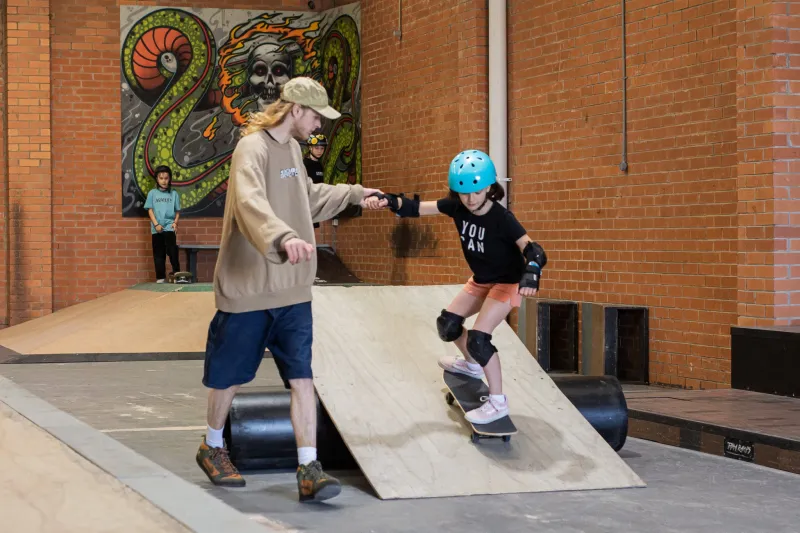
Photo: skateboarder teaching lesson urban skatepark coaching beginner, via images.squarespace-cdn.com
Let's be honest about the math. There are roughly 9 million active skateboarders in the United States. The number of people making a full-time living from traditional board sponsorships? A few hundred, maybe. The gap between those two numbers is where most skaters actually live—and increasingly, it's where some of the most interesting entrepreneurship in the sport is happening.
The old model was simple, even if it was never easy: get good, get noticed, get sponsored, get paid. That pipeline still exists, but it's narrower than ever, and the payouts at every level below the top tier have gotten thinner. Flow product doesn't pay rent. Even a modest am deal rarely covers more than gear and travel. Meanwhile, the skills and platform that skaters build over years of grinding—literal and figurative—have real market value that a lot of people are only starting to figure out how to unlock.
We talked to skaters across the country who are doing exactly that. Their approaches are different, but the underlying logic is the same: stop waiting for a brand to validate you and start building something that's actually yours.
Teaching What You Know
Coaching is the most obvious path, and it's more viable than it's ever been. Private skate lessons in major US cities now regularly run $60 to $120 an hour, and demand from parents of young kids—plus adults who picked up skating during the pandemic and never quit—has been steady.
Jordan Kessler, 29, started offering private lessons in Austin three years ago after a knee injury sidelined him from competing. "I put up a Craigslist post as a joke," he says. "Within a week I had four clients. Within a month I had a waitlist." He now runs a structured coaching operation with a handful of skill tiers, packages for beginners, and a weekend group clinic that sells out regularly. He cleared just over $58,000 last year, entirely from teaching.
The key, Kessler says, is treating it like a real business from day one. Professional liability insurance. A proper website. Consistent pricing. "Skaters undersell themselves constantly. People pay $100 an hour for tennis lessons without blinking. We bring the same level of technical knowledge to what we do."
Beyond individual coaching, skate camps are a higher-ceiling version of the same idea. Week-long summer camps in urban settings, often tied to existing youth programs or community organizations, can generate significant revenue while also doing genuine community work. Several skaters we spoke to have built relationships with parks and recreation departments or after-school nonprofits to run programming that gets partially subsidized by public funding.
Content That Actually Converts
Everyone knows you can make money on YouTube or Instagram. Fewer people know how to actually do it in a way that's sustainable without a massive following. The skaters who are cracking this aren't necessarily the ones with the most followers—they're the ones who've figured out what their specific audience actually wants to pay for.
Tamara Osei runs a YouTube channel focused on street skating technique for adult beginners—a demographic that's huge, underserved, and has disposable income. Her videos get modest view counts by influencer standards, but her conversion rate to a paid online course she launched last year has been strong enough to replace her part-time job. "I'm not trying to be a viral skate clip channel. That's not my lane. My lane is teaching a 35-year-old accountant how to kickflip without destroying their knees."
That niche specificity is the move. Broad skate content is a crowded market dominated by people with massive production budgets. Specific, useful content for underserved audiences—women's skate communities, older beginners, parents learning alongside their kids, skaters with disabilities—has room to breathe and build loyal audiences who are genuinely willing to pay for more.
Patreon and similar membership platforms are increasingly part of this picture. Skaters offering behind-the-scenes content, technique breakdowns, spot guides, or just direct community access are finding that even a few hundred paying subscribers at $5 to $15 a month adds up to meaningful supplemental income.
Merch Without the Middleman
Drop-shipping and print-on-demand have made it genuinely possible to run a small merch operation without inventory risk or upfront capital. Skaters with even modest local followings are launching branded goods—tees, hoodies, hats, stickers—through platforms like Printful or Printify connected to a Shopify storefront, and making real margins without touching a single box.
The skaters doing this well aren't just slapping their name on a blank tee. They're building actual brand identities: graphic languages, community references, inside jokes that resonate with their specific scene. The merch becomes a way for fans to identify with something, not just support an individual.
Raul Dominguez, based in Miami, launched a small brand last year built around the aesthetic of his city's specific skate scene—the colors, the architecture, the cultural mix. He did $22,000 in merch sales in his first eight months. "I'm not competing with Palace or Supreme. I'm not trying to. I'm making stuff for people who love Miami skating specifically. That's a real market."
Building Local Community as a Business
This one is less obvious but potentially the most durable. Skaters who invest in building genuine local community—organizing meetups, running informal sessions, creating online spaces for their city's scene—accumulate social capital that can be monetized in multiple ways over time.
Local brands want to reach local skate communities. Skateparks and shops want programming. Event organizers want credibility. A skater who is genuinely trusted and connected in their city has leverage that a skater with a bigger following but no local roots doesn't.
Some skaters are formalizing this into actual event production businesses—organizing competitions, showcases, and community sessions that generate ticket revenue, sponsorship from local businesses, and visibility that feeds back into their other income streams.
The Real Talk
None of this is easy. Running a coaching business means dealing with scheduling, no-shows, and liability paperwork. Content creation is a grind with no guaranteed payoff. Merch requires marketing hustle that has nothing to do with skating. Building community takes years.
But here's what's different now compared to ten years ago: the tools exist, the audience exists, and the cultural legitimacy of skateboarding—boosted by Olympic visibility and mainstream crossover—means that people outside the skate world are ready to pay for access to it in ways they weren't before.
The skaters making it work aren't waiting for someone to hand them an opportunity. They're building their own infrastructure, one lesson, one video, one community session at a time. That's pretty consistent with how skating has always operated—figure it out yourself, on your own terms, and own what you build.
That's the whole ethos, honestly. Learn it. Skate it. Own it.