Pavement PhD: The Life Lessons You Only Learn by Skating the Streets
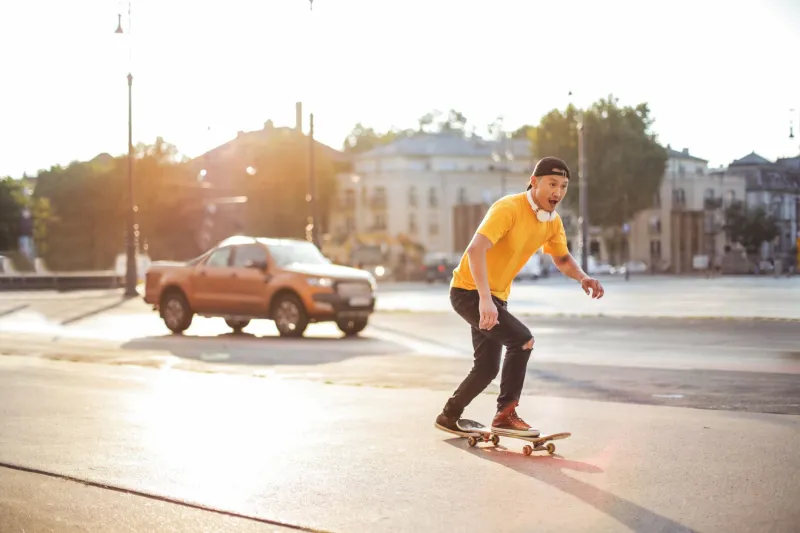
There's no syllabus. No standardized test. No guidance counselor telling you to sit down and focus. And yet, every single time a skater drops into a new spot — reading the cracks, sizing up a ledge, figuring out the angle of a gap — they're running through a mental process that most classrooms never even attempt to teach.
Street skating is an education. A real one. And the streets of America have been quietly graduating some of the most resourceful, adaptable, and creative people in the country for decades.
Reading the World Differently
Ask any skater how they see a city, and you'll get an answer that sounds nothing like what a tourist or a commuter would say. That marble ledge outside a bank? They're calculating its wax-ability and the run-up distance. That cracked parking lot behind the grocery store? They're already mentally mapping a line through it.
This is called spatial reasoning — the ability to analyze an environment in three dimensions and identify opportunities within it. It's a skill architects, engineers, and urban planners spend years developing in school. Street skaters develop it instinctively, session after session, city block by city block.
When you're constantly forced to assess terrain — slope, texture, obstacles, foot traffic, lighting — your brain builds a habit of active observation. You stop moving through the world on autopilot. That habit? It carries over into everything else.
Failure as a Feature, Not a Bug
Here's something no standardized curriculum will ever admit: failure is one of the most powerful teaching tools in existence. And street skating is built entirely around it.
Learning a new trick means falling. A lot. Sometimes for days. Sometimes for weeks. You slam, you get up, you try again with a slightly different foot position, a little more commitment, a different approach angle. Every failed attempt is raw data. You're running experiments on yourself in real time.
This is iterative thinking — the same process behind every startup pivot, every engineering prototype, every creative revision. Silicon Valley loves to talk about "failing fast," but skaters have been doing it their whole lives without a whiteboard or a venture capitalist in sight.
The mental toughness that comes from sticking with a trick through twenty, thirty, fifty attempts doesn't just make you a better skater. It rewires how you handle setbacks in every area of life. Skaters learn early that frustration is part of the process, not a signal to quit.
Improvisation and On-the-Fly Problem Solving
No two street spots are the same. A ledge that looked perfect in a clip might be crumbling when you get there. The run-up you counted on is blocked by a delivery truck. Security shows up three minutes into your session. Plans change — constantly.
Street skaters adapt. Fast. They find the next spot. They reframe the obstacle. They figure out how to make something out of nothing. That's not just a skating skill — that's entrepreneurial thinking.
It's no coincidence that the skateboarding world has produced a disproportionate number of business founders, brand builders, and creatives. Skateboarding culture — especially street skating — rewards people who can improvise, self-direct, and hustle without waiting for permission. Those same instincts translate directly into starting a business, building a creative practice, or navigating a career that doesn't follow a traditional path.
Community as Curriculum
One of the most underrated classrooms in street skating is the crew. When you're learning with other skaters, you're constantly teaching and being taught — not in a formal way, but through observation, encouragement, and honest feedback. Someone lands something you've been working on, and you study their setup. You finally stick a trick, and you break it down for the next person trying.
This is peer-to-peer learning, and research consistently shows it's one of the most effective ways humans absorb and retain information. The skate spot functions like a community of practice — a concept educational theorists have been writing about for decades, while skaters have been living it on curbs and plazas across the country.
There's also something powerful about the mentorship culture embedded in skating. Older skaters pass knowledge down to younger ones, not because they're required to, but because that's just how the community works. That kind of intergenerational knowledge transfer builds social intelligence, empathy, and communication skills that don't show up on any report card.
Creativity Under Constraints
Street skating doesn't give you a perfect skate park with smooth transitions and predictable surfaces. It gives you whatever the city left behind — a bumpy bank, a weird-angled curb, a ledge with a lip that's seen better days. And within those constraints, skaters find beauty, flow, and innovation.
That's a creative muscle. The ability to look at limitations and see possibility instead of dead ends is something artists, writers, designers, and problem-solvers spend careers trying to cultivate. Street skaters build it by default.
Some of the most iconic tricks in skateboarding history came from someone making the best of an imperfect situation — using the environment creatively rather than waiting for ideal conditions. That mindset shows up in every creative field: you don't wait for the perfect setup. You work with what you have and make something worth watching.
The Streets Don't Lie
Maybe the most honest thing about street skating as an education is that it doesn't grade on a curve. The pavement doesn't care about your excuses. Either you landed it or you didn't. Either your line worked or it didn't. That kind of immediate, unfiltered feedback builds a rare relationship with reality — one where you learn to assess your own performance honestly, adjust without ego, and keep pushing.
In a culture that increasingly insulates people from failure and honest feedback, street skating is almost radical in its directness. It demands accountability. It rewards persistence. It builds the kind of self-awareness that no classroom rubric can measure.
So yeah — go to school, get your degree, do all of that. But don't underestimate what you're learning every time you push down a city block, read a new spot, and figure out how to make something happen where nothing was promised. The streets have been teaching that curriculum for a long time. And the graduates? They're out here doing real things.