Why the Street Is the Greatest Gym You'll Never Pay For
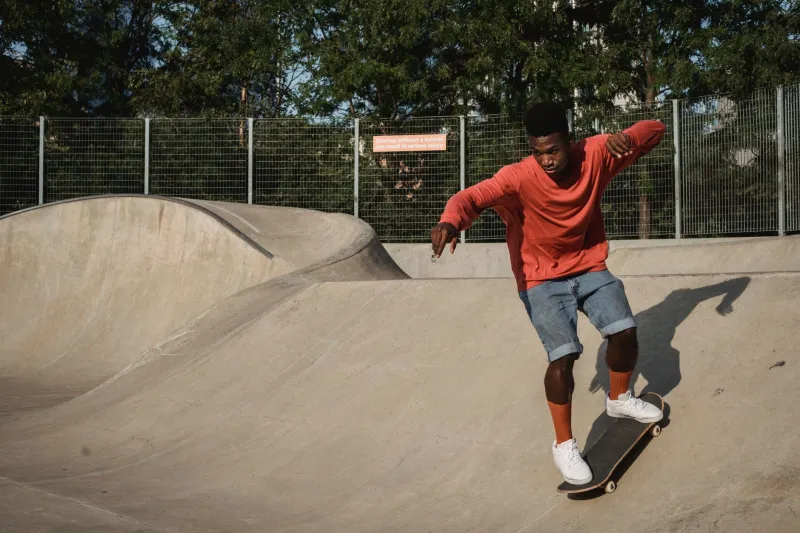
There's a version of skateboarding that happens under fluorescent lights, on freshly sealed concrete, between clearly marked obstacles spaced at consistent intervals. It's organized. It's accessible. And in many ways, it's made the sport more welcoming to a generation of new skaters.
But here's the thing nobody at the skatepark is saying out loud: the streets are making better athletes.
Not better trick performers, necessarily. Not better competitors or more Instagram-friendly skaters. Better athletes — in the truest, most biomechanically complete sense of the word. And the reasons why go a lot deeper than just "street skating is harder."
The Problem with Predictability
Skateparks are engineered environments. Every ledge is the same height. Every bank has a consistent angle. The ground doesn't crack, shift, or slope unexpectedly. That consistency is great for learning specific tricks in isolation, but it comes with a hidden cost: your nervous system stops working overtime.
When your body encounters the same stimulus repeatedly, it automates the response. That's efficient, but it's also a ceiling. Your proprioceptive system — the network of receptors in your joints, muscles, and tendons that tells your brain where your body is in space — gets lazy when nothing surprises it.
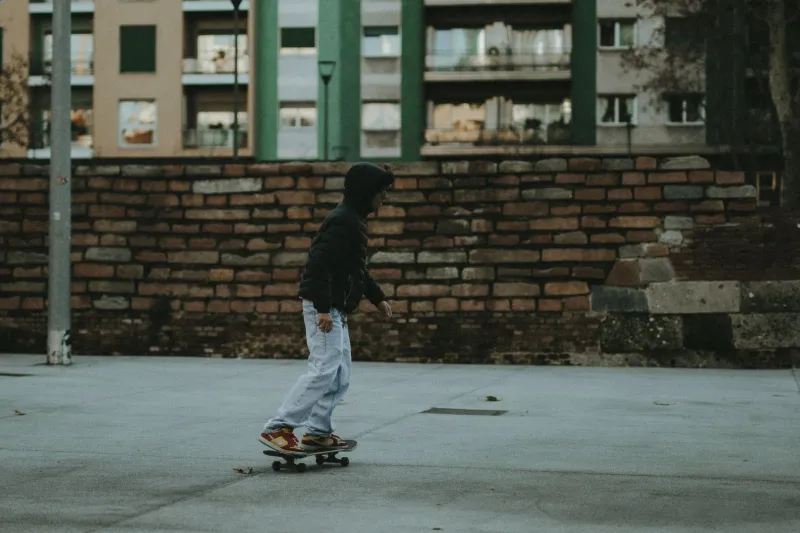
Street skating is the opposite of lazy. A cracked sidewalk in Brooklyn, a slightly off-camber loading dock in Chicago, a marble ledge in downtown LA that slopes three degrees to the left — every single one of these forces your nervous system to recalibrate in real time. You're not just executing a memorized movement pattern. You're solving a physical problem, mid-motion, at speed.
Neuroscientists call this "adaptive motor control," and it's one of the most valuable physical skills a human being can develop. Street skaters are building it constantly, without even realizing it.
Balance That Actually Transfers
Ask a seasoned street skater to skate an unfamiliar surface, and they'll figure it out fast. Ask a skater who's only ever trained at a park to navigate a rough patch of asphalt with a subtle crown in the middle, and you'll see a very different story.
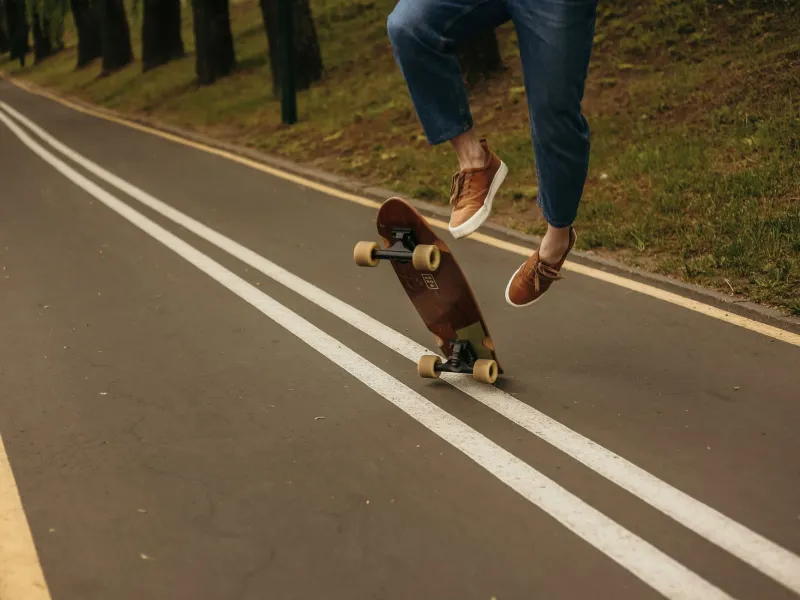
Balance isn't one skill — it's a collection of them. Static balance, dynamic balance, reactive balance. Skateparks largely train the first two. The street trains all three, because the street forces you to react. A pebble you didn't see. A grate that's slightly raised. A gap that's six inches wider than you estimated.
This kind of reactive balance training is exactly what physical therapists and sports performance coaches use to rehabilitate and strengthen ankles, knees, and hips in professional athletes. Street skaters are doing it every single session, for free, on every block they roll down.
Reading Terrain Is a Full-Body Skill
Here's something that doesn't get talked about enough: the visual processing demands of street skating are genuinely elite-level.
A park skater learns to read a fixed environment. The obstacles don't move. The lines are obvious. Over time, you stop scanning as aggressively because there's nothing new to find.
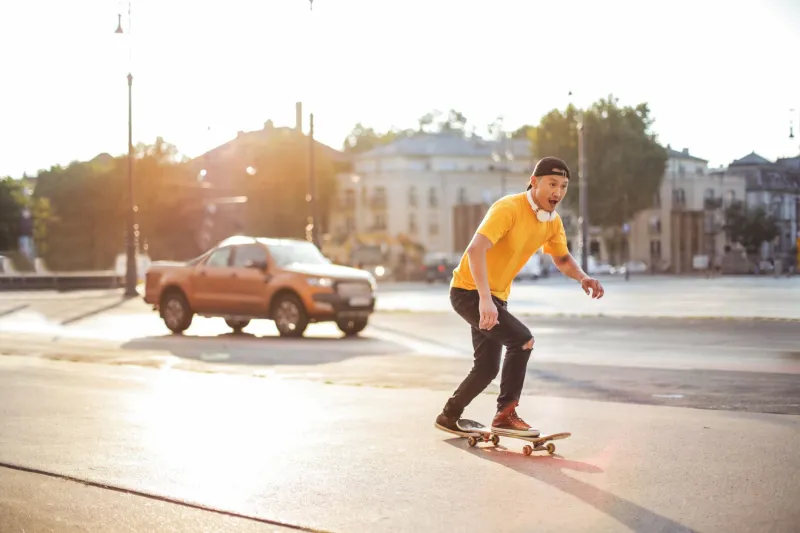
A street skater is running a continuous threat assessment. Pedestrians. Car doors. Wet leaves. That one section of sidewalk that looks fine but is actually lifted half an inch by a tree root. Your eyes and brain are processing spatial information at a completely different rate, feeding constant data to your body so it can make micro-adjustments before you even consciously register the obstacle.
This is the same kind of visual-motor integration that elite basketball players, soccer midfielders, and hockey defensemen train deliberately. Street skaters develop it organically, because their environment demands it.
The Injury Prevention Paradox
Conventional wisdom says skateparks are safer. And on a session-by-session basis, that's probably true — there are fewer variables, softer edges, and no traffic. But zoom out, and a more complicated picture emerges.
Athletes who train exclusively in controlled environments tend to be more vulnerable when they encounter unpredictable conditions, not less. Their bodies haven't developed the reactive stability to handle surprise inputs. A skater whose entire career has been spent on smooth park concrete may actually be at higher risk of a serious ankle sprain the first time they hit a rough street spot, precisely because their stabilizer muscles have never been seriously challenged.
Street skating builds what strength coaches call "functional resilience" — the capacity to absorb and adapt to unexpected forces. Your ankles learn to find ground that isn't level. Your hips learn to compensate for surfaces that push back unevenly. Your core learns to stabilize a board that's rolling over texture instead of glass. None of that happens on a freshly sealed skatepark floor.
This doesn't mean street skating is without risk. It absolutely has its own injury profile, and nobody's suggesting you skip protective gear. But the narrative that parks are categorically "safer" for long-term athletic development deserves a serious second look.
What Your Body Is Actually Learning Out There
Let's be specific. When a street skater drops off a curb they've never hit before, here's a partial list of what their body is actually doing:
- Calculating impact force based on height and speed, adjusting knee bend pre-landing
- Reading surface texture through their feet and redistributing weight across the deck
- Correcting for lateral slope in real time using hip and ankle adjustments
- Processing peripheral visual data to anticipate what comes after the landing
- Managing fear response to stay loose rather than tense through impact
That's not just skateboarding. That's a full-body athletic event happening in about half a second. Multiply that by every obstacle in a two-hour session, and you start to understand why longtime street skaters move the way they do — with a kind of fluid, instinctive grace that's genuinely hard to teach in a controlled setting.
Both Worlds, One Skater
None of this is an argument against skateparks. Parks are incredible for progressing specific technical skills, for community building, for keeping younger skaters safe while they develop fundamentals. The best skaters in the world use both environments strategically.
But if you've been spending 90% of your time inside a park because it feels more comfortable, more controlled, more correct — consider what you might be leaving on the table. The street isn't just a place to skate. It's a training system that's been developing complete, adaptive, resilient athletes since before skateparks existed.
The concrete gym doesn't have a membership fee. It doesn't have operating hours. And it will absolutely challenge you in ways that no perfectly designed obstacle course ever will.
Get out there and let it.