Skate or Graduate: What the Streets Teach You That a $200K MBA Never Will
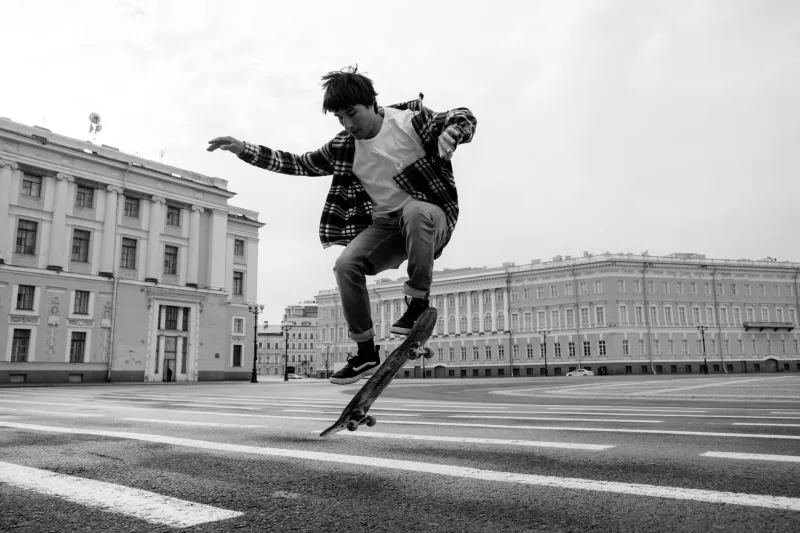
Every skater knows the feeling. You've been staring at the same ledge for forty-five minutes. You've eaten pavement twice, bruised your hip, and scuffed your favorite shoes. But something keeps pulling you back to that same spot, making you recalibrate your approach angle, adjust your foot placement, tweak your timing by fractions of a second until — finally — it clicks.
That moment? That's not just skating. That's problem-solving at its most raw and real.
While business schools charge small fortunes to teach frameworks like design thinking and iterative development, the streets have been handing out the same education for free since the first kid rolled a board down a California driveway. The methodology is messier, the classroom is concrete, and the feedback is immediate and unforgiving. But the lessons? They stick.
Every Obstacle Is a Design Problem
When a skater rolls up to a new spot — a courthouse plaza, a loading dock, a parking garage with a perfect curb cut — the first thing they do is read it. They walk the space. They watch how the light hits it, how the surface texture changes, where the cracks are, what angle gives the best run-up. They're gathering data before making a single move.
"I didn't realize it at the time, but that's literally UX research," says Marcus Webb, a 29-year-old product designer based in Austin who's been skating since he was twelve. "You're observing the environment, identifying constraints, figuring out what's possible within those constraints. I do the exact same thing when I'm designing an app interface. The vocabulary is different, but the mental process is identical."
Marcus never finished college. He spent his early twenties skating spots across the Southwest, filming clips, and picking up freelance design gigs on the side. Today he leads a product team at a mid-size tech company and credits the street for teaching him how to think spatially and systematically under pressure.
The parallel runs deeper than just observation. Skating forces you to break a complex problem — land this trick on this obstacle — into a sequence of smaller, testable components. Foot position. Speed. Pop timing. Body rotation. You isolate each variable, adjust it, and test again. Silicon Valley calls this iteration. Skaters just call it practice.
Failure Is the Curriculum
Here's something business schools love to talk about but struggle to actually teach: how to fail productively. Most academic environments punish failure. You get one shot at the exam, one chance to nail the presentation. The feedback loop is slow, the stakes feel enormous, and students learn to avoid risk rather than embrace it.
Street skating runs on an entirely different operating system.
"You fall, like, fifty times before you land something," says Deja Okafor, a 26-year-old entrepreneur from Chicago who runs a small streetwear brand she started at nineteen. "And every single fall tells you something. You don't just get back up and try the same thing again — you adjust. You figure out what went wrong. After years of that, failure genuinely doesn't scare me the way it scares some of my peers in business."
Deja's brand, which started as hand-printed tees sold out of her backpack at skate spots around Wicker Park, now moves product through three boutiques and a growing online store. She bootstrapped the whole thing, iterating on designs and marketing approaches the same way she iterated on her kickflips — constantly, without ego, and with a high tolerance for things going sideways.
Psychologists call this quality "failure resilience," and it's increasingly recognized as one of the most valuable traits in creative and entrepreneurial careers. Skaters develop it almost by accident, simply because the sport demands it. There is no shortcut to landing a trick. You cannot fake your way through it. The concrete doesn't grade on a curve.
Creativity Within Constraints
One of the most underrated aspects of street skating is how it breeds creative thinking. Unlike skatepark skating, where the obstacles are purpose-built and predictable, street skating is fundamentally about reimagining the urban environment. A handrail becomes a grind spot. A loading dock becomes a launch ramp. A cracked sidewalk becomes a technical line that nobody else would think to skate.
This is lateral thinking in its purest form — the ability to look at something designed for one purpose and see its potential for another.
"I work in architecture, and honestly, skating changed the way I see space," says Tomás Rivera, a 32-year-old based in Los Angeles who skated competitively through his early twenties before going back to school for design. "When I'm working on a public plaza or a commercial building, I'm always thinking about how people will actually move through it, how they'll interact with edges and surfaces and transitions. A lot of my colleagues have to work really hard to develop that spatial intuition. I got it for free, skating downtown LA."
Tomás now advocates within his firm for designing public spaces that are skater-friendly — not just because he loves the culture, but because he genuinely believes spaces that accommodate skating tend to be more dynamic, more human-scaled, and more alive.
Reading the Room — and the Street
There's a social dimension to street skating that rarely gets acknowledged in these conversations, too. Skaters navigate a complex social landscape every time they hit a spot. They're reading security guards, negotiating with shop owners, building rapport with locals, and managing group dynamics within their crew — all while trying to land tricks.
"You develop this really sharp emotional intelligence," says Marcus. "You learn to read situations fast. Is this security guard going to be cool or is he going to call the cops? Can I talk my way into getting five more minutes at this spot? That kind of social awareness translates directly into how I handle client relationships and team dynamics at work."
It's the kind of soft skill that hiring managers swear they're looking for but rarely find — the ability to adapt your approach based on real-time feedback from the environment and the people in it.
The Street Was Always the Classroom
None of this is to say that formal education doesn't have value, or that everyone should drop out and go skate (though, honestly, some days it's tempting). The point is simpler and more urgent than that: the skills that street skating builds — analytical thinking, creative problem-solving, resilience, adaptability, spatial reasoning, emotional intelligence — are exactly the skills that matter most in a rapidly changing economy.
And the street has been teaching them all along, to anyone willing to show up, take the falls, and keep adjusting.
At Urban Skate Academy, we've always believed that skating is bigger than a sport. It's a way of engaging with the world — curious, persistent, creative, and unafraid of the pavement. Whether you're a beginner just figuring out how to push, or a seasoned skater who's been reading spots for years, you're already enrolled in one of the best schools out there.
The tuition is just a few bruises. The degree lasts a lifetime.