Why You're Stuck: The Brain Science Behind Skate Plateaus and How to Actually Break Through Them
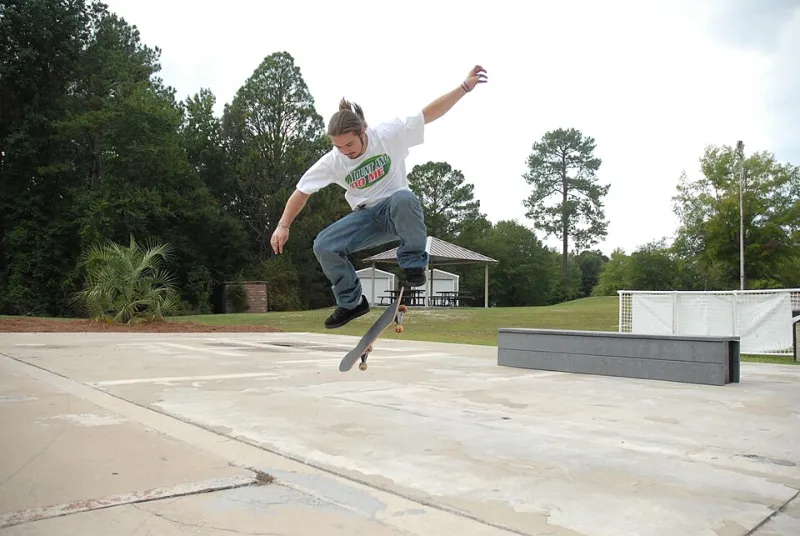
Photo: SUSANNE KAPPLER, Public domain, via Wikimedia Commons
You've been working on heelflips for three weeks. You've spent entire afternoons at the same spot, logging attempt after attempt. Your friends are texting you from other sessions and you're declining because you're this close. And yet — nothing. The trick still isn't clicking. Your board still isn't doing what your brain is telling it to do.
This is one of the most frustrating experiences in skateboarding, and it's also one of the most universal. Every skater hits walls. But most skaters have no idea why those walls exist or how to actually get over them. They just push harder, skate longer, and wonder why the results don't match the effort.
The answer, it turns out, has less to do with skateboarding and more to do with how your brain builds new skills — and once you understand that process, the whole game changes.
What's Actually Happening in Your Brain When You Learn a Trick
Learning a new physical skill isn't a smooth upward line. It's a series of uneven jumps separated by long flat stretches. Sports scientists call these flat stretches plateaus, and they're not signs that you're doing something wrong — they're a built-in feature of how motor learning works.
When you attempt a new trick, your brain is essentially writing a new program. It's mapping the timing of your feet, the weight shift in your hips, the pop of your back foot, the catch — all of it — into a neural pathway. Early on, this process is slow and clumsy because the pathway is new. That's why tricks feel awkward before they feel natural.
Here's the part most people don't know: the actual consolidation of that skill — the moment the pathway gets reinforced and stabilized — often happens offline. Meaning during sleep, during rest, during the hours when you're not skating. Research from motor learning labs consistently shows that people perform better on newly learned physical skills after a night of sleep than they do right after the practice session itself. Your brain is literally processing what you practiced while you're doing other things.
This means that the skater who sessions hard, rests, and comes back the next day is often building skill faster than the skater who spends six straight hours at the same spot trying to brute-force a single trick.
The Repetition Trap
There's a deeply embedded belief in skate culture that more attempts equals more progress. Grind the spot until you get it. Run it back until it sticks. This mindset has produced some incredible skaters, but it's also produced a lot of overuse injuries, burnout, and inexplicable regression.
Motor learning research points to something called massed versus distributed practice. Massed practice means doing the same thing repeatedly in one long block. Distributed practice means spreading attempts across multiple shorter sessions with rest in between. For most complex physical skills — and skateboarding is extremely complex — distributed practice produces better long-term retention.
The practical implication: you're probably better off spending 45 focused minutes on a trick, going home, sleeping, and coming back tomorrow than you are spending four hours on it in a single session. Your body gets fatigued, your form degrades, and you start reinforcing sloppy attempts rather than clean ones.
Every bad attempt you land is also being recorded by your nervous system. You're not just practicing the trick — you're practicing the version of the trick you're currently doing, flaws and all. Quality of attempts matters as much as quantity.
Why Filming Changes Everything
One of the most underrated training tools in skateboarding is also the one every skater already has in their pocket: their phone camera.
Filming your sessions creates a feedback loop that your brain genuinely cannot generate on its own. When you're skating, your proprioception — your internal sense of where your body is in space — is often significantly off from what's actually happening. Skaters consistently overestimate how high they're popping, how clean their foot placement is, and how controlled their landings look. The footage doesn't lie.
Watching yourself skate, even casually, gives you visual data that your brain can actually use to recalibrate. You'll spot the exact moment your back foot is coming off too early, or notice that you're throwing your shoulders when you don't need to. Coaches in other sports use video review as a standard part of training. Skaters have had access to this tool forever and most still treat it purely as a content creation exercise rather than a learning one.
Film your attempts. Watch them the same day. Look for one specific thing to fix and focus on that.
Terrain Variation Is a Cheat Code
Another counterintuitive finding from skill acquisition research: practicing in varied environments actually accelerates learning more than practicing in a single controlled environment, even though it feels harder in the moment.
This is called contextual interference, and it works because variation forces your brain to reconstruct the motor program each time rather than running on autopilot. When you practice a trick at the same spot every day, your nervous system starts to rely on environmental cues specific to that spot — the texture of the concrete, the slight slope, the familiar lighting. Move to a different spot and suddenly the trick falls apart.
But skaters who intentionally mix up their terrain — smooth concrete today, rougher asphalt tomorrow, a slight incline the day after — build more robust, transferable skills. The trick becomes truly yours rather than a spot-specific pattern.
This also explains why some skaters who look incredible at their home park completely fall apart in a new environment. They've drilled the trick in one context instead of internalizing it across many.
The Mental Side of Plateaus
It's worth acknowledging that not all plateaus are purely physical. Some of them are psychological — and these can be even harder to break through.
Fear of commitment is one of the most common hidden blockers. You think you're trying the trick, but some part of your nervous system is protecting you by pulling back at the last second. This is especially common with anything involving height, gaps, or impact. Your brain is doing its job — it's just doing it at the wrong time.
The solution isn't to ignore the fear. It's to reduce the stakes incrementally. Skate something slightly smaller until the commitment feels automatic, then step up. Trying to willpower your way through genuine fear usually just reinforces the hesitation pattern.
Mental fatigue is also real and underappreciated. Decision fatigue, frustration, and anxiety all degrade motor performance measurably. If you're showing up to a session already stressed about other things, your ceiling for that session is lower before you even push off.
A Better Approach to Getting Better
None of this means you should skate less. It means you should skate smarter. Shorter, more focused sessions. Real rest between them. Film yourself and actually watch the footage. Move between spots and surfaces. And when you hit a wall on one trick, pivot to something else for a session or two — you'll often come back to the original trick with a fresh nervous system and land it faster than if you'd never stopped.
Progression isn't linear, and it was never supposed to be. Understanding that takes the pressure off and, paradoxically, tends to speed things up. The streets aren't going anywhere. Give your brain time to catch up.