Streets as a Teacher: How Urban Architecture Builds Better Skaters Than Any Bowl
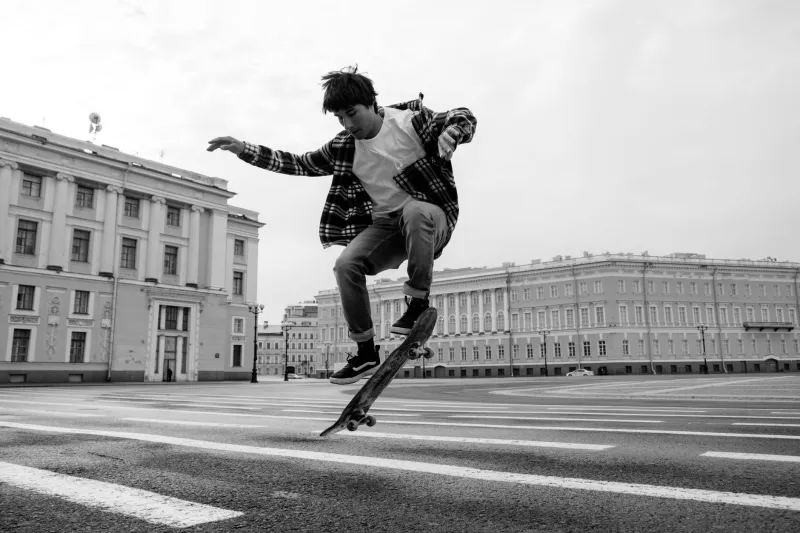
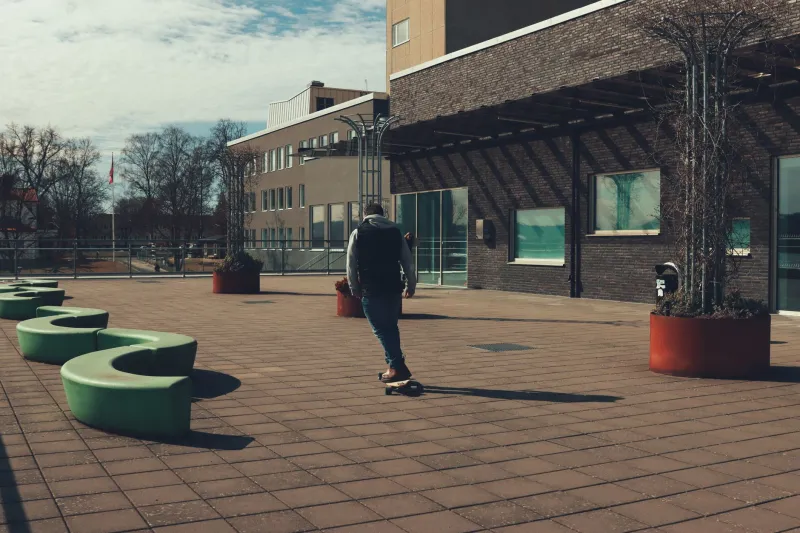
Skate parks are great. Nobody's knocking them. But here's something every skater who came up grinding curb cuts and hopping plaza ledges already knows in their bones: the street teaches differently. It doesn't hold your hand. It doesn't offer you a perfectly waxed ledge at an ergonomic height. It throws a cracked sidewalk at you, a rail with a weird angle, a stairset that's slightly off-center, and it says — figure it out.
That's not a flaw in the curriculum. That's the whole point.
Urban architecture was never designed with skaters in mind, and that's exactly what makes it the best classroom in the world. Every building, plaza, staircase, and loading dock was built for a specific human purpose. When skaters interact with those structures, they're forced to adapt, improvise, and problem-solve in ways that a foam-padded skate park simply can't manufacture. The city is alive, unpredictable, and unforgiving — and learning to skate it makes you a fundamentally more well-rounded rider.
Let's break down what the concrete classroom is actually teaching you.
Courthouse Steps and the Gospel of Consistent Landings
There's a reason so many legendary clips were filmed on government plazas. Courthouse steps, city hall entrances, federal building staircases — these spots share a common architectural trait: they're built to exact specifications. Uniform rise, uniform run, hard granite or concrete surfaces with zero forgiveness.
When you're learning to ollie down a three-stair at your local park, the transition ramp at the bottom cushions a bad landing. Courthouse steps don't do that. You either land it clean or you feel every ounce of that concrete through your ankles. Over time, that environment trains your body to nail the pop, nail the timing, and nail the landing position — because the alternative hurts.
Skaters who develop their stair game on real architecture consistently show better board control under pressure. They've been graded on a curve that doesn't curve. That kind of repetition on unforgiving surfaces builds muscle memory that park skating just can't replicate at the same intensity.
Ledges That Weren't Made for You — and Why That's Perfect
A purpose-built skate park ledge is set at a height someone calculated to be ideal. It's waxed, or made from a material that grinds smoothly. There's a run-up designed to give you the right approach speed.
A downtown plaza ledge? That thing was built for people to sit on during lunch. The height might be awkward. The edge might be rough granite, or a weird marble composite that grabs your trucks in unexpected ways. The run-up might be a slightly sloped brick surface that messes with your push.
All of that is the lesson.
Grinding and sliding inconsistent surfaces teaches you to adjust your weight distribution in real time. You learn to read how a material is going to behave before you commit — the way granite locks up differently than concrete, how marble can be slick in ways that feel like cheating until you understand the speed adjustment it requires. Skaters who've put in hours on real ledges develop a tactile intelligence about surfaces that is genuinely difficult to teach any other way.
Banks, Walls, and the Art of Reading Angles
Every city has them: parking garage entrances, retaining walls, the angled bases of buildings, drainage banks behind shopping centers. These architectural features weren't built as transition — they're incidental geometry. And incidental geometry is one of the street skater's greatest teachers.
Bank skating forces you to think about momentum management in three dimensions. You're not just going up and coming back down a predictable quarter pipe. You're navigating a surface that might change angle mid-run, that might have a seam or a crack that redirects your board, that might end abruptly at a curb or a wall.
Learning to pump a parking garage bank or carve a retaining wall develops an intuitive sense of speed control that translates everywhere else in your skating. It teaches you how to generate and bleed speed without relying on a perfectly shaped transition. That skill shows up when you're trying to link a line across multiple elements — which brings us to the spot that doesn't get enough credit.
Loading Docks: The Unsung Master Class in Line-Finding
If courthouse steps are the classroom for landings and plaza ledges are where you learn surface reading, loading docks are the graduate seminar in creative line construction.
A loading dock environment typically gives you a mix of everything: raised platforms at multiple heights, metal rails with industrial angles, concrete lips, gaps, and usually a lot of open ground to work with. Nothing connects the way it would in a designed skate space. There's no obvious line — which means you have to create one.
This is where skating stops being about individual tricks and starts being about flow, vision, and spatial intelligence. How do you get from the ground to the dock edge? What's the approach angle that lets you hit the rail without killing your speed? Can you find a line that strings three elements together without a dead stop in between?
Some of the most creative skaters in any city have loading dock spots they've been studying for years — not because the individual features are special, but because the puzzle never fully gets solved. There's always a new combination, a new angle, a new way to read the space.
The Mental Game the Street Teaches That Parks Don't
Beyond the physical skill development, skating urban architecture builds something harder to quantify: situational awareness and creative problem-solving under real-world conditions.
At a skate park, the environment is controlled. At a downtown plaza, you've got foot traffic, security guards, wet ground from a street cleaner that came through an hour ago, and a ledge that's at a slightly different height on one end than the other because the ground settled over twenty years. You have to assess all of that before you skate it. You have to adapt your plan mid-session when conditions change.
That mental flexibility is a skill. And it makes you better at skateboarding in every context — including back at the park, where you'll start seeing the designed features differently because you've learned to read space rather than just react to it.
How to Start Reading Your City Like a Textbook
If you've been mostly a park skater and want to develop your street game, start small and stay observant. Walk your city blocks with skater eyes. Look at every surface change, every ledge height, every stairset. Ask yourself: what would I need to do to skate that? What's the approach? What's the exit?
You don't have to skate everything you see. Half the education is in the reading. Over time, you'll develop an architectural vocabulary that makes every city you visit feel like a new textbook — full of lessons you haven't learned yet.
The concrete classroom never closes. And the tuition is just a pair of shoes and the willingness to fall down on something that doesn't apologize for being hard.