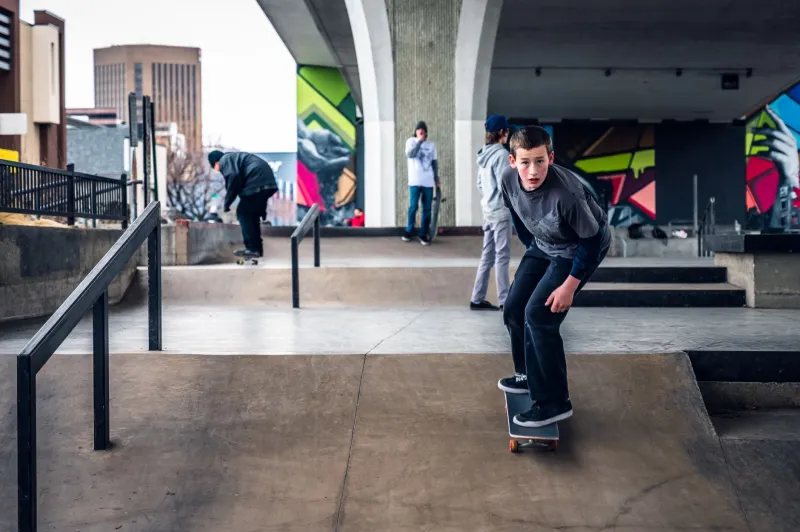
Why Skating in Front of Strangers Makes You Better Faster Than Any Private Lesson Ever Could
Picture this: You've been working on a heel flip in your driveway for two weeks. You land it maybe once every ten tries. Then one afternoon you roll up to a busy plaza downtown, a handful of older skaters posted up near the ledges, some kids watching from a bench. You set up, push, pop — and stomp it first try. Clean.
What just happened?
It wasn't luck. And it wasn't magic. There's a real, documented psychological mechanism at work when skaters practice in open, social environments versus quiet, private ones. And once you understand it, you'll never look at a crowded skate spot the same way again.
The Science of Skating With an Audience
Researchers have been studying what happens to human performance under observation since the early 1900s. Social facilitation theory — first proposed by psychologist Norman Triplett and later expanded by Robert Zajonc in the 1960s — suggests that the presence of other people actually enhances performance on tasks you've already started to master. Your nervous system reads an audience as a signal to activate. Heart rate rises slightly. Dopamine and norepinephrine flood the system. You become more alert, more precise.
For skaters, this translates directly. When you're rolling through a familiar trick in a social setting, that mild arousal state tightens your timing, sharpens your foot placement, and pulls your body into the muscle memory it's been building. The audience doesn't distract you — it charges you.
"There's a reason athletes talk about performing better in competition than in practice," says Dr. Melissa Rand, a sports psychologist who has worked with action sports athletes across the West Coast. "The social pressure isn't the enemy of learning. It's actually a catalyst — but only when there's enough foundational skill to work with."
Failure as a Public Performance
Here's where street skating gets really interesting from a learning standpoint: unlike a gym or a private skate session, the streets don't let you quietly reset after a slam. When you eat it on a manual pad in front of twenty people, everyone sees it. And that visibility changes the way your brain processes the failure.
Neuroscience research on error-related negativity — the brain's automatic response to making a mistake — shows that public failures trigger a stronger signal than private ones. That stronger signal means your brain encodes what went wrong more deeply. You don't just know you leaned too far forward; you feel it in a way that sticks.
Skate coaches at community programs across cities like LA, Chicago, and New York have noticed this pattern for years, even without the lab data to back it up.
"Kids who only practice at home in front of a camera — they get good at landing for the camera," says Marcus Webb, a long-time skate instructor based in Brooklyn who has been teaching street skating for over a decade. "But when they come out to a real spot with real people around, their whole game changes. They start reading their mistakes differently. They get tougher, but also smarter."
The Peer-Learning Loop That Nobody Talks About
Beyond the audience effect, there's another dimension of public skating that private lessons simply can't replicate: the informal, peer-driven knowledge exchange that happens organically at any decent skate spot.
You try a trick. You bail. Some dude you've never met walks over and says, "Yo, you're popping too early — try waiting an extra beat." You try it. You get closer. He nods. You try again.
That interaction — unscripted, unscheduled, completely voluntary — is one of the most effective forms of skill transfer that exists in any sport. Sports education researchers call it "observational learning" and "peer modeling," and studies consistently show it accelerates skill acquisition faster than top-down instruction alone.
Why? Because the feedback is immediate, contextual, and comes from someone who has literally just done what you're trying to do. There's no translation layer between the advice and the application. The spot itself is the classroom, and everyone in it is both student and teacher.
Resilience Is Built on the Pavement, Not in the Playbook
There's a softer skill being developed out there too — one that doesn't show up in any trick progression chart but matters enormously for long-term development as a skater and, honestly, as a person.
When you fail in public, repeatedly, and keep going anyway, you're training your tolerance for discomfort. You're learning to separate your identity from the outcome of any single attempt. You're building what psychologists call psychological resilience — the ability to absorb setbacks without collapsing.
This is something that controlled environments, for all their value, struggle to manufacture. A skate school with padded floors and a patient instructor is a fantastic place to learn the fundamentals. But the street is where those fundamentals get stress-tested, where they either hold up or expose their cracks.
"The kids who progress the fastest in our program are almost always the ones who spend the most time skating outside of lessons," Webb notes. "Not because the lessons don't matter — they do — but because the street teaches a different kind of courage. It teaches you to keep going when it's not comfortable."
How to Use This to Your Advantage
Understanding the psychology of public skating isn't just interesting trivia — it's a training tool. Here's how to put it to work:
Seek out spots with people. Don't wait until you feel "ready" to skate in front of others. The discomfort itself is part of the curriculum. Find a spot with a mix of skill levels and just show up.
Let yourself fail visibly. Resist the urge to only attempt tricks you're confident about when people are watching. Controlled risk-taking in social environments is where the deepest learning happens.
Engage with the skaters around you. Ask questions. Watch closely. Offer what you know. The peer-learning loop only works if you participate in it actively, not just passively.
Use private practice to build, public skating to test. Think of solo sessions as loading the gun and street sessions as pulling the trigger. Both are necessary. Neither is sufficient on its own.
The Streets Have Always Been the Best Teacher
Skateboarding wasn't born in a gym or designed by a committee. It grew up on sidewalks and parking lots and schoolyard banks, passed from person to person through demonstration and failure and stubborn repetition. The social, public nature of street skating isn't incidental to the culture — it is the culture.
And as it turns out, that culture was doing something pedagogically sophisticated long before anyone had the research vocabulary to describe it. The concrete classroom has been open for decades. You just have to show up — even when people are watching. Especially when people are watching.