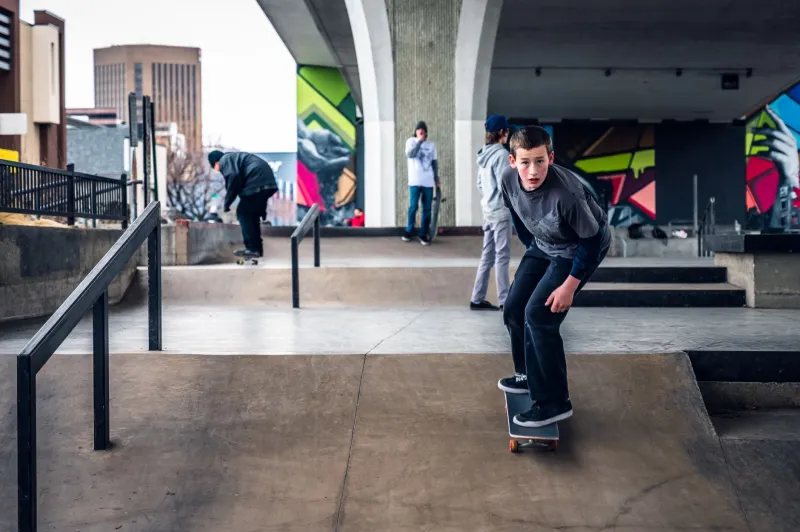
Fall, Adjust, Repeat: Why Skaters Are the Problem-Solvers Every Employer Is Desperate to Hire
There's a moment every skater knows. You've tried the same trick forty times. Your shins are bruised, your patience is shot, and your friends have long since moved on to another spot. But somewhere between attempt thirty-eight and thirty-nine, something clicks — a slight shift in your back foot, a fractional change in your pop timing — and suddenly the board does exactly what you've been demanding of it for the past two hours.
That moment? Silicon Valley pays serious money to replicate it in conference rooms.
"What skaters do naturally is what we spend months trying to get engineers to do," says Marcus Webb, an engineering team lead at a mid-size Austin-based software firm who also happens to have been skating since he was twelve. "They form a hypothesis, test it under real conditions, observe the failure, adjust the variable, and run the experiment again. That's agile methodology. That's design thinking. That's literally the framework we teach in onboarding."
The connection between skateboarding and professional problem-solving isn't just a feel-good narrative. It's a pattern showing up across industries — from product design studios in San Francisco to startup accelerators in New York — where hiring managers are quietly learning to read between the lines of a résumé that mentions skate experience.
The Pavement Is a Feedback Machine
Street skating, unlike almost any other sport or hobby, offers instant, unforgiving, and highly specific feedback. Land wrong and the board tells you exactly how wrong. The pavement doesn't soften the blow or grade on a curve. That kind of radical accountability to results — not effort, not intention, but actual outcomes — shapes how skaters approach every challenge they encounter.
Pro skater and Los Angeles native Dani Reyes, who's been skating street for over a decade and recently launched her own small-batch skate apparel line, puts it plainly: "School taught me that getting the right answer was the goal. Skating taught me that getting the wrong answer fast and learning from it was actually more useful. I burned through probably a hundred failed business ideas before I found one that worked, and I just treated every one like a trick I hadn't landed yet."
That mindset — treating failure as data rather than defeat — is something organizational psychologists have been trying to cultivate in corporate teams for years. It has a name in startup culture: the "fail fast" philosophy. Skaters have been living it on curbs and ledges since before most of today's tech founders were born.
Decomposing the Impossible
Watch a skater learn a new trick and you're watching an instinctive systems thinker at work. Before they even step on the board, most experienced skaters mentally break the move into components — foot placement, timing, weight distribution, eye focus, landing stance. They don't just "try the trick." They isolate variables, test individual elements, and rebuild the full sequence once each piece is working.
Jordan Calloway, a UX designer at a product agency in Chicago, says this decomposition habit is what sets skaters apart in his field. "When I'm working through a complicated user flow, I naturally break it into micro-interactions and test each one independently before I try to string them together. I learned that from skating. You don't try a handrail before you've got the flat-ground version locked. Same principle applies to designing a checkout process."
This kind of structured, modular thinking is a cornerstone of both software development and product design — and it's not easy to teach. Bootcamps and design programs spend significant time and curriculum trying to build this habit. Skaters develop it organically, through necessity, on the streets.
Pressure, Stakes, and Real-World Conditions
There's another dimension to street skating that classroom education simply can't replicate: performing under variable, unpredictable conditions with real consequences. A skate park is controlled. The street is not. Traffic, uneven pavement, pedestrians, security guards, weather — every session is a live exercise in adapting your plan when the environment refuses to cooperate.
"I hire for adaptability above almost everything else," says Priya Nair, a product director at a New York e-commerce company who has interviewed hundreds of candidates over her career. "The people who grew up in environments where the rules changed constantly, where they had to improvise and adjust in real time, those are the people I want on my team when a product launch goes sideways at 11pm. Skaters, honestly, fit that profile really well."
Dani Reyes echoes this from the skater's side of the equation. "Every session, something unexpected happens. The spot got waxed weird, there's a crack you didn't see, a car parks in your line. You don't give up and go home. You read the new situation and figure out what's possible. That's just how you think after years of skating."
The Collaboration Nobody Talks About
Street skating looks like a solo sport from the outside. But anyone who's actually part of a skate crew knows it's deeply collaborative. Skaters coach each other, hype each other up, offer technical feedback, and collectively problem-solve spots. That social dimension builds a specific kind of teamwork — low ego, direct communication, genuine investment in each other's progress — that translates directly into functional team dynamics.
"In skating, if someone's close on a trick, you tell them exactly what you saw that was off," says Marcus Webb. "There's no sugarcoating because sugarcoating doesn't help them land it. That's the kind of direct, constructive feedback culture every tech team wants and almost none of them actually have."
What the Streets Built That the Classroom Didn't
None of this is to say traditional education is worthless — but it's worth being honest about what it often fails to produce. Most academic environments reward correct answers over creative iteration. They penalize failure rather than treating it as a learning mechanism. They rarely simulate the kind of real-stakes, real-time pressure that street skating applies every single session.
The result is a generation of workers who are technically knowledgeable but sometimes brittle when things go wrong — who haven't built the psychological muscle to fail publicly, recalibrate quickly, and try again without losing momentum.
Skaters build that muscle every time they step on a board.
"I've never put 'skateboarding' on my résumé," Dani Reyes admits, "but honestly, it's probably the most relevant thing on there. Every skill I use running my business — the grit, the systems thinking, the comfort with uncertainty — I developed it on the streets, not in a classroom."
Maybe it's time that changed. Because the concrete has been teaching problem-solving all along — we just haven't been calling it by its corporate name.